
Industrial use of artificial intelligence refers to applying data-driven algorithms, machine learning, and related software to operational processes in factories and production systems. In this context, AI systems process sensor signals, machine logs, and enterprise data to detect patterns, infer equipment condition, and support decisions about maintenance, inspection, scheduling, and material flows. These systems typically integrate with programmable logic controllers, enterprise resource planning systems, and industrial networks so that analytical outputs align with control and planning workflows.
Implementation commonly involves structured data pipelines, model training on historical process records, and deployment on edge devices or cloud services for runtime inference. AI methods may include supervised learning for classification, unsupervised techniques for anomaly detection, and optimization algorithms for planning. Practical adoption often requires cross-functional collaboration among engineering, operations, data science, and IT teams to ensure data availability, model validation, and safe integration into production environments.

Predictive maintenance applications typically start with data collection from condition-monitoring sensors and historical maintenance records. Data preprocessing often includes filtering, feature extraction, and labeling of known fault events. Common predictive approaches may use time-series models, classification, or survival analysis to estimate remaining useful life or probability of failure within a given horizon. Practitioners often view model accuracy and false alarm rates as trade-offs; reducing false positives can avoid unnecessary interventions, while missing early signs may allow faults to progress. Integration with maintenance workflows and spare-parts inventory is frequently necessary for operational value.
Visual inspection systems often require annotated datasets that reflect real production variability, including lighting changes, part orientation, and acceptable tolerances. Transfer learning and data augmentation may be applied to reduce the volume of labeled examples needed. In-line inspection may run inference on edge devices to meet latency and bandwidth requirements, while higher-capacity training and model updates commonly occur on centralized servers. When deploying vision solutions, teams typically evaluate metrics such as detection rate and false-reject rate and plan for periodic retraining as process conditions shift.
Robotic automation combined with AI can support adaptive tasks where variability in parts or positions is present. Approaches include model-based control augmented by perception and data-driven planners that learn from demonstrations or simulation. Safety considerations are central: collaborative robots often operate with force-limited modes and require safety-rated sensors or fences depending on task risk. Scaling robotic solutions may involve assessing cycle time impacts, tool-change logistics, and the extent of human oversight needed to handle exceptions and non-routine tasks.
Production planning and supply-chain analytics often use optimization and forecasting methods that can incorporate AI-generated demand signals or supplier performance indicators. Forecasting models may combine historical demand, promotions, and external data streams to suggest production volumes, while optimization routines can consider capacity constraints and lead times. Interpreting model outputs within planning cycles requires clear interfaces and scenario analysis so planners can understand suggested schedules and contingencies. Data quality, latency, and the alignment of business rules with model outputs are frequent implementation considerations.
AI applications in manufacturing involve technical, organizational, and operational components that together determine practical outcomes. Data readiness and governance commonly influence the pace at which specific use cases move from pilot to sustained operation. Technical choices about edge versus cloud inference, model explainability, and human-in-the-loop validation often shape where and how systems are adopted. The next sections examine practical components and considerations in more detail.
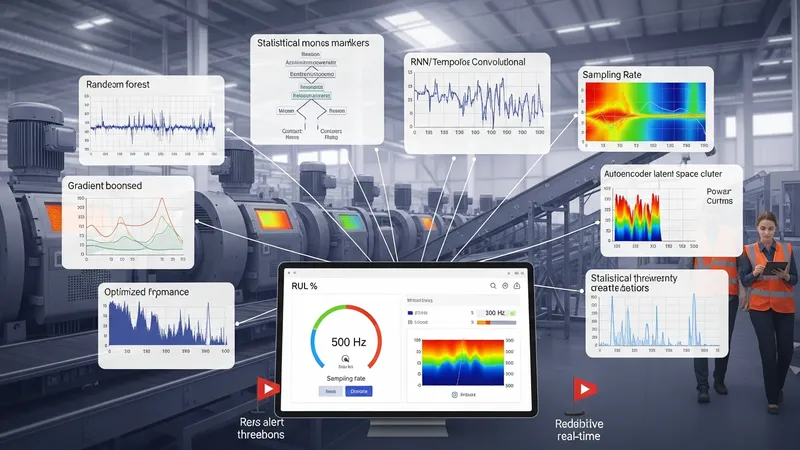
Predictive maintenance systems typically combine multiple sensor streams—vibration, acoustic, thermal, and electrical measurements—with historical maintenance and failure logs to detect precursors of equipment degradation. Time-series feature engineering such as spectral features, statistical moments, and trend indicators may feed machine learning models that estimate probabilities of failure or remaining useful life. Teams often pilot models on a subset of assets to validate signal relevance and to tune alert thresholds that balance early warning with manageable technician workload. Considerations include sensor placement, sampling rates, and procedures for collecting labeled failure events, which can be scarce in low-failure environments.
Model selection for asset monitoring often includes classical algorithms such as random forests and gradient-boosted trees, along with recurrent neural networks or temporal convolutional models when sequence dependencies are strong. Unsupervised methods like autoencoders and clustering may detect anomalies without explicit fault labels, which can be helpful where labeled data is limited. Practitioners typically validate models using holdout periods and simulated degradation scenarios, and establish monitoring to detect model drift. Instrumenting feedback loops—where maintenance outcomes are fed back to retrain models—helps maintain model relevance over time.
Operational integration often requires translating probabilistic model outputs into maintenance actions via decision rules or risk matrices. For example, a moderately elevated failure probability may trigger increased inspections, while a high probability could prompt scheduled downtime. Linking models to spare-part inventories and maintenance workforce planning is commonly necessary to realize operational improvements. Software integration with computerized maintenance management systems (CMMS) and scheduling tools helps ensure that alerts generate actionable work orders and track resolution metrics for continuous evaluation.
Practical constraints include data quality issues such as missing timestamps, inconsistent units, or sensor drift, which can degrade model performance. Insider considerations include starting with high-value asset classes, using simple baseline models for transparency, and gradually introducing more complex algorithms once data processes are stable. Teams often prepare playbooks that define who reviews alerts, how to validate predictions, and how to escalate ambiguous cases. These considerations may support reliable deployment while keeping interventions proportionate to predicted risk.
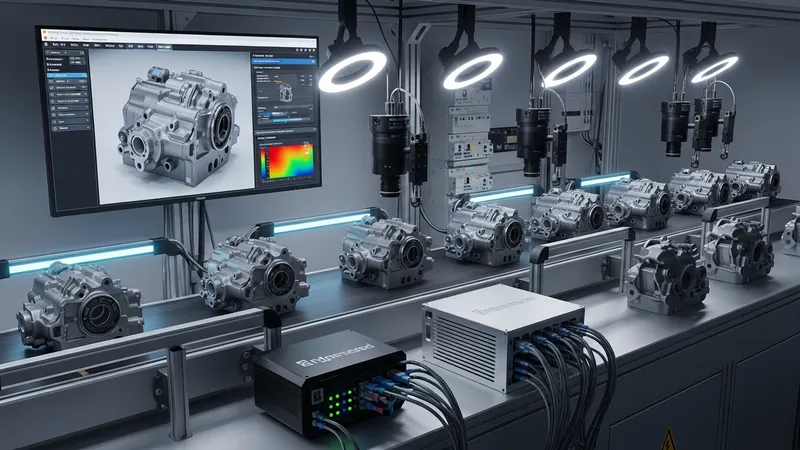
Image-based inspection systems typically capture high-resolution images under controlled lighting and use convolutional neural networks or classical computer vision pipelines to identify defects. Data collection aims to sample the range of normal variation and known defects; annotation quality directly affects model accuracy. When defects are rare, synthetic augmentation and staged defect introduction can help generate training examples. Edge deployment is common for latency-sensitive lines: models run on embedded accelerators or small form-factor inference devices and return pass/fail decisions that integrate with line PLCs or supervisory systems.
Model robustness is a common challenge: variations in lighting, camera angle, or part orientation may produce spurious alerts. Techniques like multi-view capture, normalization of images, and continuous monitoring of false-positive rates are used to maintain performance. Human review workflows are often retained for borderline cases to ensure production quality while models improve. Periodic revalidation and scheduled retraining are typical, especially after a supplier change, tooling replacement, or process adjustment that affects the part appearance.
Process automation that follows inspection often includes routing rejected parts to rework stations, adjusting machine parameters, or triggering additional inspection steps. Integration with programmable logic controllers and manufacturing execution systems (MES) requires mapping model outputs to deterministic control actions and safety checks. Considerations include defining tolerances for automated interventions, ensuring traceability for rejected units, and planning rollback procedures when models are updated to avoid unintended production impacts.
Insider tips include starting inspections on stable, high-throughput lines where the cost of rework is measurable, and piloting systems in parallel with human inspectors to build confidence. Teams may adopt ensemble approaches—combining rule-based checks with ML classifiers—to capture both known defect signatures and novel anomalies. Clear logging of model decisions and a protocol for investigating recurring false alerts can facilitate continuous improvement and alignment with quality management processes.
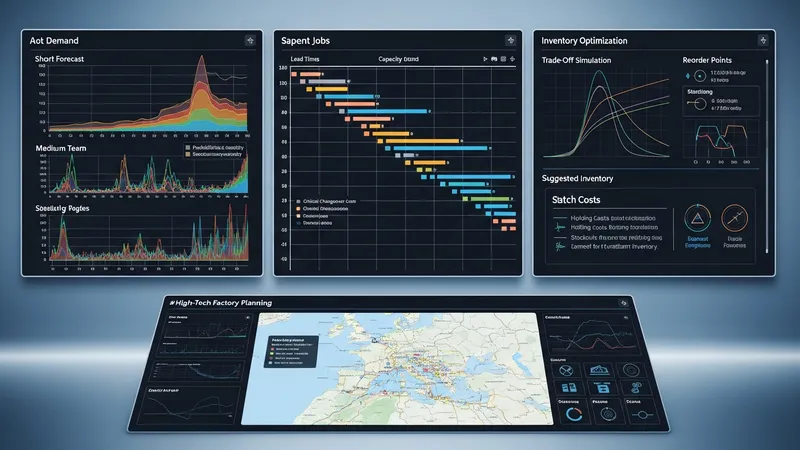
Forecasting models often combine historical demand data, seasonality, and external indicators to generate short- and medium-term demand signals that feed production planning. Machine learning methods such as gradient-boosted trees and recurrent architectures can model complex patterns, while probabilistic forecasts provide measures of uncertainty used in planning buffers. Planners commonly integrate AI outputs into constraint-based scheduling algorithms that consider capacity, lead times, and changeover costs to produce feasible schedules. These systems may be run as scenario analyses so planners can compare outcomes under different demand or supply assumptions.
Inventory optimization uses demand forecasts and lead-time variability to suggest reorder points and batch sizes; stochastic optimization or simulation can quantify trade-offs between holding costs and stockout risks. Supply-chain analytics can also use anomaly detection to flag supplier delays or transportation disruptions based on transactional and telemetry data. Effective implementation typically requires clean master data for part definitions, lead times, and routing information, and attention to alignment between model assumptions and real-world constraints like minimum order quantities or shelf life.
Human oversight remains important: planners often review algorithmic schedules to incorporate tacit knowledge about customer priorities, maintenance windows, or market events not captured in available data. Transparency in model outputs—such as explainable features or scenario visualizations—can help build trust and support adoption. Combining AI-driven recommendations with collaborative planning meetings and what-if analyses may yield more resilient operational plans that blend statistical signals with domain expertise.
Practical considerations include computing and integration choices: some organizations run forecasts in cloud-based analytics platforms, while others prefer on-premises solutions to keep data within factory networks. Insider guidance suggests validating models across multiple product families and time horizons, and maintaining simple fallback rules in case of data outages. Tracking forecast accuracy over time and linking improvements to operational KPIs such as cycle time, fill rate, or inventory turns helps quantify the contribution of analytic tools.
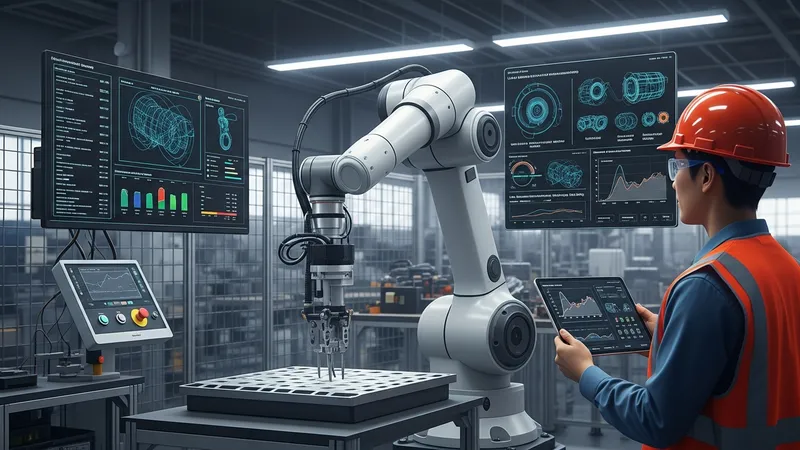
Robotics applications that incorporate AI range from flexible pick-and-place using vision-guided grasping to adaptive control for force-sensitive assembly. Learning-based methods such as imitation learning or reinforcement learning may be used for complex manipulation tasks, although these techniques often require simulation and domain randomization to reduce training time on physical hardware. Collaborative robots with force sensing and safety-rated speed limits can work alongside operators for tasks that benefit from human judgement. Integration requires assessing the task cycle, safety zones, and tolerance for variation to determine appropriate robot classes and control architectures.
Data governance and model lifecycle management are essential for reliable operation: teams commonly implement versioning for models, datasets, and inference code, together with monitoring that tracks input distributions and performance metrics. Explainability and traceability help when investigating incidents or unexpected behavior. Governance frameworks often define roles for data stewards, ML engineers, and operations leads to ensure clear ownership of model updates, testing, and rollback procedures. Compliance with industry safety standards and internal audit requirements frequently shapes deployment timelines and documentation needs.
Human factors are important: introducing AI-enabled automation can change operator tasks, shifting focus from manual execution to exception handling and system supervision. Training programs that present system limitations and expected failure modes may support smoother adoption. Insider considerations include designing operator interfaces that provide clear state information and recommended actions, and staging automation in ways that preserve operator agency and safety. Continuous feedback loops that capture operator corrections can also supply labeled examples for future model improvement.
Maintenance of deployed AI systems typically blends software and mechanical maintenance practices. Scheduled model retraining, calibration of sensors, and verification of perception pipelines are common tasks. Teams often prepare runbooks that describe how to validate system health, interpret alerts, and execute fallback procedures when models degrade. These practices, combined with incremental rollouts and careful metric tracking, may support sustainable adoption while reducing operational surprises.